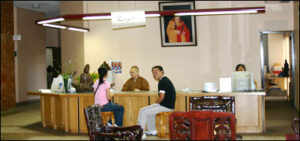
 The tour begins at the reception desk, to the right of the main entrance as you enter the building.
Above the windows, adjacent to the desk are two water color pictures of the completed Guesthouse and Main Temple Complex. The painting on the left is the Guesthouse. The Main Temple, with the orange roof, is Fo Guang Shan’s spiritual headquarters for the continent of Africa. Fo Guang Shan, meaning Buddha Light Mountain, is the name of our Order. The main temple is built to last for 500 years if not maintained and up to 1000 years if it is maintained. It is the largest Buddhist Temple in the Southern hemisphere. Underneath the central Shrine will be a very large conference facility capable of accommodating 800 people.
The name of this temple, “Nan Hua”, means “Southern Flower” in Mandarin Chinese. It refers to the location of the Temple and symbolizes virtue and beauty. The picture hanging above reception is of Venerable Master Hsing Yun, the founder of the Fo Guang Shan order.
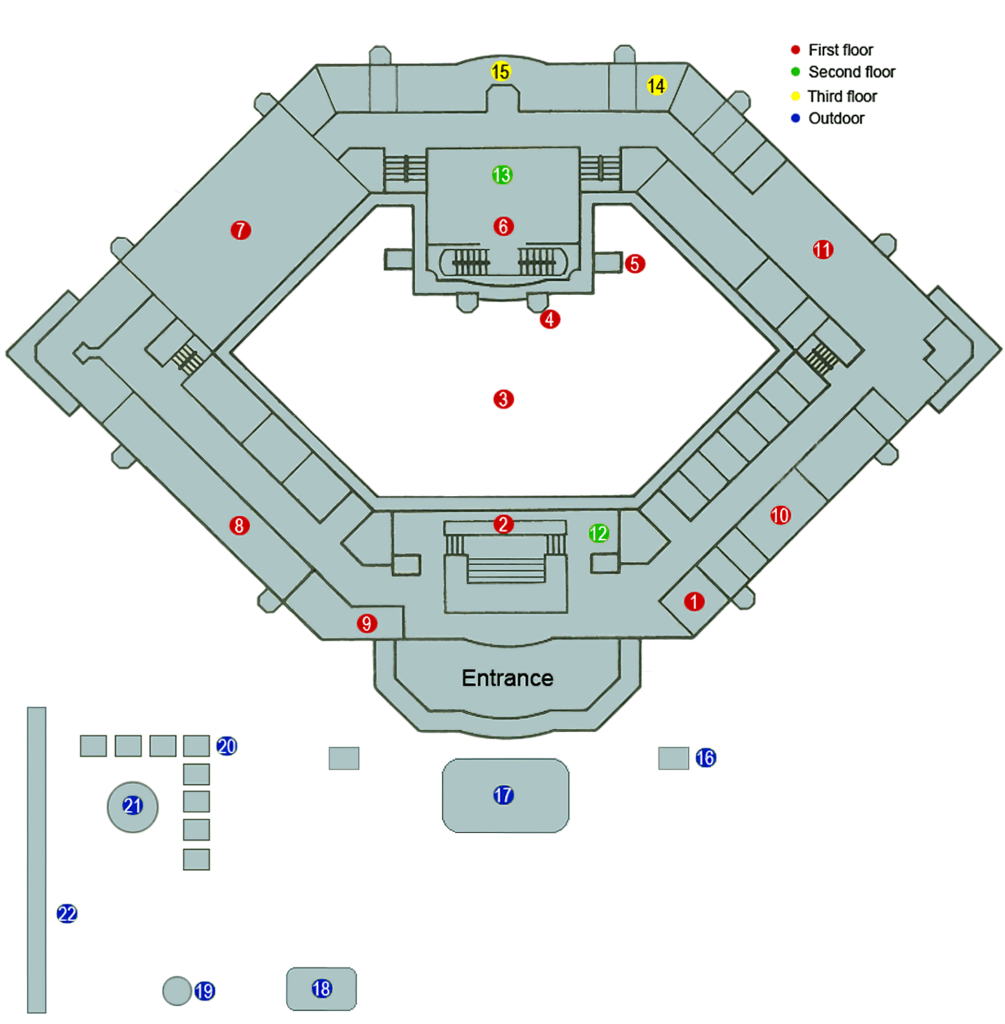
On the ground floor of this building are the administration offices, curio shop, Repentance Hall, museum, conference rooms, dining hall and kitchen. On the second floor are guestrooms, coffee shop, (open only on Sundays) monastic quarters and the Samantabhadra Shrine. The meditation Hall, used on our weekly meditation retreats, is on the top floor above the kitchen area, looking out over the fields behind the temple.
Behind the large staircase in the center of the reception area is a very large set of Chinese gongs. This is a life size model of gongs originally constructed by students of Jiao Tong University during the Han Dynasty in China, roughly 2000 years ago. They were donated to the Temple by a Buddhist devotee. These gongs are ornamental and are never played. Unlike western bells, which are rung by means of a device on the inside, Chinese bells and gongs are struck on the outside. These bells are played by two people using long wooden poles resembling rounded oars. The Emperors of old were entertained by the music of such bells and dancing.
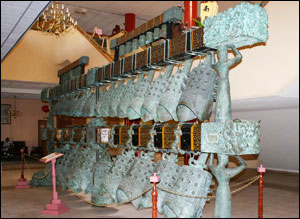 Under the staircase in the main entrance is a set of impressive antique Chinese Palace gongs.
These are a replica of the original, which dates back approximately 2000 years to the Han Dynasty in ancient China. They are played by at least 2 people, using special wooden poles.
The gongs were used to signal the start of various functions and the arrival or departure of various residents or visitors to the palace. They constitute an effective way of transmitting public information over quite an extensive distance.
The gongs in the guesthouse, however, are only models and thus not intended to be played.
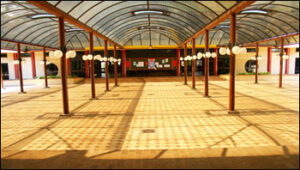 The courtyard is through the glass doors behind the bells. The Guesthouse is built according to the plan of a traditional Chinese Palace, complete with courtyard and throne room – now a shrine room. The garages and storerooms at the back of the guesthouse were the palace stables. The wide driveway, now parking area, was the palace market place. A mural depicting Sakyamuni Buddha, the founder of Buddhism, teaching the Dharma to beings from all realms of existence, can be seen on the wall above the dining hall.
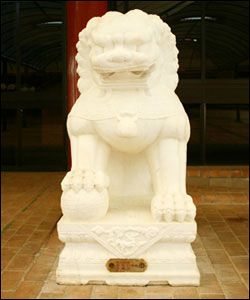 On either side of the stairs to the Dining Hall are large white Temple Lions. They are to be found at main entrances and gates around the Temple and are Temple protectors. They are mythological animals called Dogs of Fu, the miraculous progeny of a Pekinese dog and an African Lion. This is why they appear more dog than catlike. It is also the reason why both male and female have manes. The ball in the mouth is a symbol of trust. The lion will neither bite nor swallow the precious jewel, which is a symbol of life. The male has a ball under his foot demonstrating his protective power. The cub under the female’s foot shows her gentle, female quality and the vigilance of a mother who fiercely defends her offspring. It is believed that malevolent beings, seeing these strange beasts, will be terrified and flee.
Hanging above the female, to the left, is a wooden fish. Traditionally, the fish hung outside the bathrooms. It was struck at set times during the day to call monks and nuns to their ablutions. This fish is just an ornament.
Wooden boards are struck at the Temple to wake people and to call them to services and meals. Different patterns of hitting the board are used for different calls. The same signals that were used thousands of years ago are still used today.
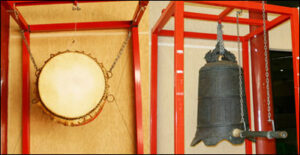 Across the courtyard, to the left of the Dining Hall, is an inscribed bell, held from above by two dragons. Together with the drum, on the other side of the dining hall, and accompanied by chanting, it is played every morning and evening to open and close the Temple. The bell is inscribed with two central Buddhist scriptures: The Diamond Sutra and the Great Compassion Mantra. The former is a profound Buddhist teaching that instructs aspirants to Buddhahood on how they should conduct themselves and on the correct perception of reality. The latter is a prayer of adoration to Kuan-yin, the Bodhisattva of compassion. This mantra brings comfort and relief to beings in all realms. The sound of the bell is said to reverberate in the ten directions, through all the realms of existence.
After the bell and chanting comes the drumming. As he beats the drum, the drummer visualizes a thunderstorm bringing life sustaining rain. He calls on Medicine Buddha to protect all beings in the Temple as well as outside seeking refuge and solace within its walls.
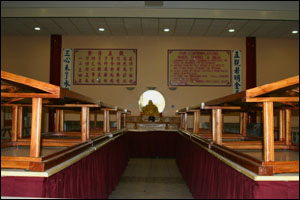 The dining Hall is up the stairs, through the glass doors. Here monks, nuns, novices and workers eat together. Often guests join the Temple staff for meals. At the far end is the Dining Hall Shrine. The Buddha on the Shrine is Maitreya, the coming Buddha. Every Chinese Buddhist Temple Dining Hall has a Shrine with Maitreya Buddha on it and is called “The Hall of Five Contemplations”.
Maitreya Buddha is portrayed as a fat, laughing monk with a large sack, sometimes surrounded by playful children. His is the most widely recognized Buddha image in the West and many believe he is the one and only Buddha. Some Westerners also believe he is the Buddhist God. This is not true. In fact, Buddhists believe there have been and still will be, infinitely many Buddhas. Buddhists do not believe in an omnipotent, omniscient God of creation.
According to Buddhist belief, Maitreya is presently a Bodhisattva, named Ajita, living and teaching in the Tushita Heaven. A Bodhisattva is a being who has attained great compassion, wisdom and virtue but has delayed becoming a Buddha in order to help alleviate the suffering of all other beings.
The Buddhist statues and pictures symbolize and remind us of the virtuous characteristics of the great beings. These qualities are also latent in ordinary people and can be mindfully cultivated so that we become the best people we can be.
The five contemplations, on the wall to the left of the shrine in English, and on the right in Chinese, are to be reflected upon as one eats in silence. Eating is regarded as an opportunity to develop self-awareness and gratitude.
Some monastics take only two meals a day: breakfast and lunch, taking only liquids after midday. One of the reasons for this is that it is not practical for monks, who beg for their food, to go out on alms rounds more than once a day. Another is that it is believed that we do not need to eat three times a day and that we are healthier and can make greater spiritual progress if we do not over eat. We meditate better and need less sleep.
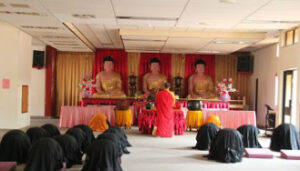 The Repentance Hall is on the ground floor to the right as one leaves the Dining Hall. Shoes are placed on the shoe shelf outside the shrine. Dharma services are held here on Sunday mornings. Members of the public are welcome to attend.
Repentance is a very important concept in Buddhism, differing somewhat from the Western concept of “confession”. It involves understanding that our wrong or “unwholesome” actions are a result of ignorance. Repenting, we promise to stop doing the things that cause pain and to do things that benefit others and ourselves. The practice of repentance often involves prostration. This is not idol worship but the remembrance of our teacher, Sakyamuni Buddha and the recognition that we too, have a pure Buddha mind.
There are four shrines in the Repentance Hall: the Sakyamuni Buddha Shrine, the Medicine Buddha Shrine, the Kshitigarba Bodhisattva Shrine and the Kuan-yin Bodhisattva Shrine.
The main shrine is the Sakyamuni Buddha Shrine on which are three large figures representing Sakyamuni Buddha, the most important Buddha in the Repentance Hall, in the centre, Amitabha Buddha of the Western Pure Land, on the left and Medicine Buddha, on the right. The physical features of the three Buddhas are the same. The mudras, or posture of the hands distinguishes them. Amitabha Buddha holds the lotus flower signifying the Land of Ultimate Bliss. Sakyamuni Buddha’s hands are in the mudra of meditation while the medicine Buddha holds a round crystal jewel indicating his healing powers. The monk who leads the service sits on the ornate throne in front of the Buddhas.
Sakyamuni Buddha
Sakyamuni Buddha was born 2600 year ago in northern India to Warrior King Suddhodana Gotama and his wife, Maya. When he was an infant it was predicted that he would become either a great king or a world-changing spiritual leader. The prince, Siddhartha, led a protected and luxurious life. He was an exceptionally kind, gentle and gifted student. Shortly after he married, he encountered, for the first time, sickness, old age, death and the aesthetic life These experiences changed his life. He decided to abandon his life of excessive luxury and resolved to find a way to alleviate human suffering.
At the age of twenty-nine he left his palace and set off as a wondering monk, on his search for truth. For six years he studied with the greatest spiritual teachers of the time trying to find a way to end suffering. He practiced such extreme austerities that he became ill and emaciated but still had not achieved enlightenment. Finally he abandoned all extremes. Sitting under the famous Bodhi Tree, he resolved not to get up until he had become enlightened. There he achieved liberation becoming a Buddha or awakened one. He spent the next forty-five years of his life teaching the Dharma or Truth and the method to end suffering and attain perfect bliss.
Amitabha Buddha
Amitabha, meaning infinite life and infinite light, has been described as “the archetype of cosmic compassion”. He is the central figure of the Pure Land School of Buddhism, presiding over the Western Pure Land or Land of Ultimate Bliss, where anyone can be reborn through utterly sincere recitation of his name. Having attained the Pure Land, even ordinary mortals, burdened with painful karma, can achieve liberation, safe in an environment free of negative distractions and temptations.
Medicine Buddha
Opposite the shrine of Sakyamuni Buddha is the shrine of the Medicine Buddha who reigns over the Pure Lapis Lazuli Paradise in the East. He heals the ills of body and spirit including that of ignorance. Above the shrine, on red cards, are the names of people who are physically or mentally ill. Their names are placed here in order to receive the blessings of Medicine Buddha. Buddhists believe that the merit or compassionate energy of those praying to the Medicine Buddha will help cure those who are ill.
Kshitigarba Bodhisattva
To the right of the Medicine Buddha shrine is the Kshitigarba or Earth Store Bodhisattva Shrine. Kshitigarba is usually represented standing, holding in his right hand a pilgrim’s staff and in his left a pearl. His head is either shaved or he wears a crown.
Like all Bodhisattvas, he aspires to deliver all sentient beings from their miseries but he specializes in liberating beings suffering in the hell realms. He vowed, “Not until the hells are emptied will I become a Buddha.” With inconceivable compassion, he takes upon himself the fearful task not merely of bringing relief and consolation to those in torment, but of personally transforming and uplifting the vast inchoate mass of fear, hatred and despair in the hells. He is the supreme embodiment of spiritual optimism, which wills that not so much as a grain of dust should be left outside the scheme of salvation. Around the shrine are yellow cards bearing the names of deceased loved ones. Their families are praying for them and asking Kshitigarba to help them.
Avalokitesvara Bodhisattva
Opposite Kshitigarba, is Avalokitesvara (Kuan-yin), the Bodhisattva of Compassion. In the Tibetan tradition Avalokitesvara is represented as male. In the Chinese tradition Kuan-yin is female. On this shrine her hands are in the mudra of warding off evil. The hand facing outwards signifies kindness toward and protection of all living beings. The inward-turned hand reminds us to be on guard against our own evil thoughts and to constantly strive to purify ourselves. Sometimes depicted with as many as 1000 arms with an eye on each palm and many heads to see and help beings in all directions, Kuan-yin is known as the “Goddess of Mercy” and “She who hears the cries of the world”
 The entrance to our museum is located at the far side of the Gift Shop, see our signs in this regard.
The museum contains interesting artifacts, all of which are Chinese, but not all of which are Buddhist. There are beautiful examples of traditional blue and white Chinese porcelain, as you enter the museum. In the glass case running the length of the wall are numerous wooden carved and painted statues of the Bodhisattva, Kuan-Yin.
In the glass cases that run down the middle section of the museum are different displays, showing for example Chinese tea-sets, used in formal tea-drinking ceremonies, various Chinese musical instruments, writing brushes used for Chinese calligraphy and other displays of Buddha statues etc.
There are also exhibitions of religious implements used in Tibetan Buddhist practice, examples of Monastic clothing, Buddhist Sutras and other Buddhist artifacts.
The exhibition ends with the “King’s Bowl” reputed to have been used by kings from long ago, who needed to refresh themselves after a long days journey on horseback. They knew how to rub the handles of this specially carved bronze bowl to make the water spray upwards to cleanse their face, without having to bow down to the bowl as a commoner would. Come and see if you can make the water spray up to you and show that you were a king in a past life!
The museum is open daily from 09h00 to 17h00.Entrance is free.
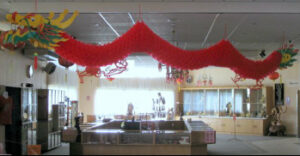 Our Curio Shop has been revamped and is now full of exotic and beautiful new stock directly imported from Mainland China. Our dedicated staff members,have just completed unpacking and arranging everything for you to peruse at your leisure.Some of the new items include:
- Exquisite boxed pictures containing traditional Chinese artifacts
- Sandalwood Malas – used for chanting mantras and blessings
- Feng Shui ‘lucky’ money attracting icons
- Varieties of Chinese tea and tea ceremony implements
- Traditional Chinese toys for children – these are unique in South Africa
- Miniature water features – ideal for your apartment, to bring the refreshing energy and the sound of flowing water to your home
- Hand-sewn Chinese indoor slippers, glittering with beads and sequins
- Wide selection of CD’s and tapes with classical Chinese music,to listen to while sipping fragrant tea from hand-painted porcelain tiny cups.
- Stick and powder incense, redolent of the mysterious East
- Elegant bangles, carved from an unbroken piece of Jade
- Buddhist artifacts and statues to adorn your shrine at home and much, much more
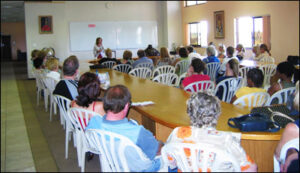 Our Meeting Room can be found behind the Reception area of the Guesthouse. It can seat 50 people around the horse-shoe shaped conference table. Additional people can be seated at the back of the room if necessary.
A permanent whiteboard is on the wall at the head of the table. Microphones can also be provided, should you so wish. There is also a small kitchen and cloakrooms in the immediate vicinity.
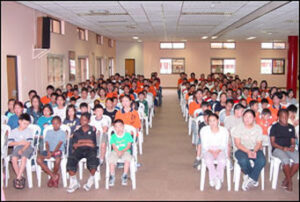 This is situated inside the Guesthouse and can accommodate
from 20 to 80 people quite comfortably. There is easy access to
a small kitchen and cloakrooms.
We can provide your group with chairs, tables, sitting cushions, microphones, whiteboard, flip chart etc. Just let us know your requirements and we will do the rest.
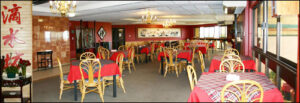 At the top of the staircase to the right is our elegant Coffee shop, noted for it’s tasteful, oriental décor. However, the pleasure is not just to be found from the eye, but also from the tastes of the simple, delicious dishes prepared here.
There is the option of a good cup of coffee and a slice of the cake of the day, or, if you are feeling a little more adventurous, why not try a bowl of traditional Taiwanese noodles and later some green tea, to aid the digestion and leave you feeling refreshed and energized.
Other varieties of tea are available, as are fruit juices and mineral waters.
If you have a sweet tooth, perhaps an ice cream pancake would satisfy you and all the while, there is the most beautiful view of the Main Temple Complex to look at.
Our Coffee shop is open daily from 10h00 to 17h00, closed on Mondays.
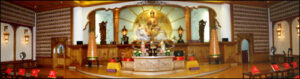 Stairs leading to the Samantabhadra Hall, (Pu Hsien Shrine Plan of First floor Guest House Plan of First floor Guest House Pu Hsien Shrine , in Chinese), which is above the Dining Hall, are on either side of the foyer to the Dining Hall. Shoes are removed before entering shrines as a mark of respect.
The Samantabhadra Hall is the main shrine room in the Guesthouse. The white elephant, on which Samantabhadra sits, symbolises spiritual practice through strength, stamina, diligence and firm resolve. The elephant’s six tusks represent the six virtues of an accomplished practitioner, namely morality, patience, charity, effort, concentration and wisdom. They also represent the six realms of existence: the hell, animal, hungry ghost, human, angry god and heavenly realms. The Bodhisattva holds a scroll in his left hand, containing his Ten Great Vows, describing the perfect practice for becoming a Buddha. His right hand points skyward in the mudra (gesture) of compassion. His right foot, resting on a lotus held up by the elephant’s trunk, indicates his readiness to spring into action to help suffering beings. Samantabhadra personifies the transcendental practices of all Buddhas. Each of his Great Vows is written in Chinese on the ten lamps, five on either side of the Shrine.
On either side of the Main Shrine are two fierce looking statues. These are the Temple Dharma Protectors. In ancient times, in pre-Buddhist Tibet, they were a cruel and angry warring people. After receiving and practicing the Buddha Dharma (teachings of the Buddha), they achieved liberation. Out of gratitude, they vowed to protect all virtuous beings who purify themselves and benefit others. The fierce demeanour of the statues signifies that all beings have the potential to be either evil or good. Each must choose which to manifest.
On either side of the altar are the Dharma instruments that are used during services to guide the chanting and help everyone to chant in unison. On the right is the gong and smaller hand-bell. The gong is used to announce the service to beings throughout all realms. On the left of the altar is the big wooden fish (mui, in Chinese) and next to it, on the smaller table, a small wooden fish. The small wooden fish is struck to keep time while chanting. The fish are stylised Koi. In Chinese culture, the Koi represents longevity, which is sought after and regarded as a blessing by Buddhists. Fish, having no eyelids, are always awake. This signifies constant awareness – a state Buddhists seek to achieve.
Fo Guang Shan Order is financed entirely by donations. This Temple was built with funds from generous donors in Taiwan and is maintained by donations from overseas and local donors. The Temple is very grateful to its donors and tries to acknowledge them in every way possible. The two towers of light, on either side of the shrine, recognise the generosity of our donors. In each alcove is a tiny statue of the Buddha, a light and the name of a devotee who has made a large donation to the Temple. The names below the small wooden statues of Samantabhadra lining the walls at the sides and back of the shrine also acknowledge generous gifts to the Temple. Specific items and even buildings around the Temple displaying a name on them indicate that the item was donated by one of our generous donors. Buddhists regard donating goods or money to Temples as very meritorious because it helps spread the Buddhist message of compassion and wisdom thereby relieving suffering.
On the low tables in the shrine, where people sit for services, are bookstands holding the sutras or religious texts that are being chanted during the services. The stands and sutras are covered with small, embroidered cloths. This shrine is used for early morning and evening services.
Above the entrance to the shrine, is a sauvastika, flanked by two lilies. The sauvastika has been used in Hindu and Buddhist cultures for the past 3,000 years to represent life, sun, power, strength, and good luck. It was adopted by the Nazis, turned around and pivoted as the emblem of Nazi Germany, and became known as the Swastika. Just as the beautiful lotus flower, rooted in the filth of the pond, symbolises purity, so human enlightenment arises from our greedy, angry, deluded, everyday minds.
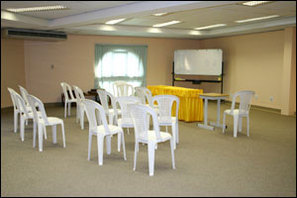 This is situated on the third floor of the Guesthouse, adjoining the
Meditation Hall. A kitchen is next door and cloakrooms are in close proximity.
We can provide your group with chairs, tables, sitting cushions, microphones, whiteboard, flip chart etc. Just let us know your requirements and we will do the rest.
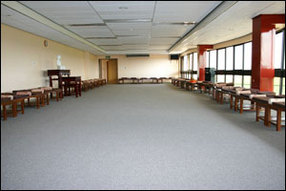 The Meditation Hall is situated on the third floor of the Guest House and is primarily intended for formal sitting meditation and/or yoga sessions.
It is equipped with it’s own sound system and has traditional Chinese sitting benches and cushions. It can accommodate up to 50 people for meditation, although if yoga sessions are also involved, we would recommend that there be not more than 35 people in this hall.
There is an adjoining kitchen and cloakrooms, as well as a small lecture room, which accommodate up to 40 people comfortably.
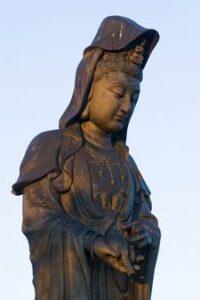 The Chinese know this Bodhisattva as Guan Shr Yin Pu Sa, and the Tibetans, as Cherezig. In the Pali or Tibetan traditions the Bodhisattva is represented as a masculine emanation and in the Chinese culture as feminine. Cultural perception has determined how the Bodhisattva has chosen to manifest in order to transmit the teachings and be of benefit to differing sentient beings. These bronze statues show her pouring the essence of compassion from the vessel in her hands.
In short, any living being that contemplates and whole-heartedly invokes the name of this Bodhisattva, in times of trouble or strife of any conceivable nature, will be heard from anywhere at any time and answered, and the distressed being will be spared of whatever difficulty they had encountered.
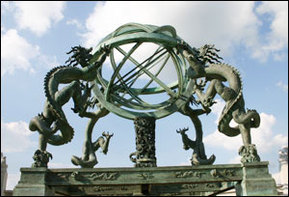 “The armillary sphere is an instrument that models the celestial sphere with respect to the horizon of an observer. It is made up of rings (known in Latin as armillae) representing the great circles on the celestial sphere such as the horizon, the celestial equator, the colures and the ecliptic. They can be adjusted to any latitude and can be used either as an instrument of observation or as a tool of demonstration….
Smaller versions were popular as a model of the universe and for demonstrating the principles of spherical astronomy and the motions of the heavenly bodies. Demonstrational armillary spheres would include additional rings delineating the tropics and the polar circles as well as a central earth surrounded by a set of nested rings representing the sun, the moon and the planets.”
Robert van Gent
The Chinese armillary sphere in front of the door to the Guesthouse is a replica of an antique model. Note the dragons supporting the sphere. It is cast in bronze and was donated by a devotee of the Temple.
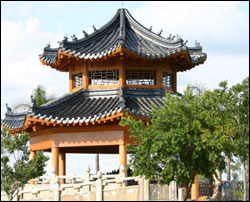 There are 2 black roofed small structures outside the Guesthouse, one on each side of the road. The traditional Chinese roofs cover miniature models of Borobudur Temple, which is located in Central Java, Indonesia. It is considered to be one of the seven wonders of the world.
The actual size of Borobudur is 2.5 kms square. It was built by Sanmaratungga in the 8th century and belongs to the Buddhist Mahayana tradition. Based on the inscription, dated 842AD, it was suggested that Borobudur was at one time a place for praying. It was found buried and in ruins by Sir Thomas Stanford Raffles in 1814. Restoration projects commenced in 1905 and the last such project was completed in 1983.
The Temple is built in a conical form (stupa) with 10 floors, rising to an original height of 42 meters, but now only 34.5 meters, after restoration. The 1st floor to the 6th was square in shape and the 7th to the 10th floors were round.
Along the corridors are long series of carved reliefs, which express the previous lives of the Buddha, when he was a Bodhisattva.
The big Stupa in our garden is a replica of the exact size of the stupas found on the top levels of Borobudur. The design of this Stupa is said to be of Indian origin.
Traditionally Stupas are found all through the East and originally had the cremation ash or relics of the Buddha or Saints buried beneath them.
In our Stupa you will note that there is a figure of the Buddha sitting inside, facing north. This is to remind us that we are disseminating Buddhism northwards through the continent of Africa.
On the outskirts of the Meditation Retreat Centre, situated 1.5 ms behind the Guesthouse, there are 14 such Stupas.
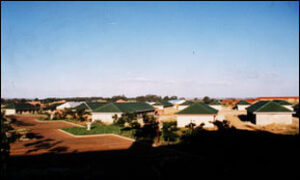
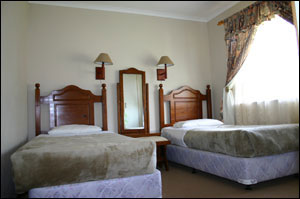
This is our complex of luxurious western style chalets, which provide accommodation for our visitors and retreatants to the Temple.
Each chalet has 2 bedrooms, one of which has a bathroom en-suite. The second twin bedroom has it’s own separate bathroom.
There is a small kitchen where refreshments can be made and a small lounge area to relax in, thus a maximum of 4 people are permitted to stay in 1 chalet.
Each chalet has security doors both front and back. The maximum group of people that we could accommodate at any one time would 200 people in Nan Hua Village.
To review our pricing structure for the rental of the above facilities, we refer you to our Cost Information link.
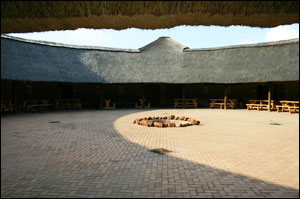 Our traditional African Lapa is situated in the middle of Nan Hua Village. It is fully equipped with all amenities, like a kitchen, cloakrooms, and a fire-pit in the center. There is also a glassed-in area which is very useful, should it begin to rain unexpectedly.
We will provide you with chairs, tables etc. A sound system can also be arranged. The lapa can accommodate up to 300 people and is a superb venue, especially on summer evenings, when the starry sky is displayed above, or on clear, winter days.
As with all our venues, advise us of your requirements and we will do our best to arrange everything for you.
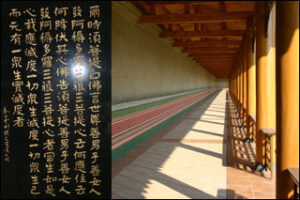 As you approach the entrance to the Guesthouse, you will note a long, high wall along the perimeter.
This is the Sutra Wall, which is still under construction. When complete, it will provide a Meditative Walk for retreatants and devotees, visiting our Temple. They will be able to walk along the wall, reading the Lotus Sutra, which is carved on the granite tablets, still to be attached to the wall.
The Lotus Sutra contains very profound teachings of the Buddha and may be accessed from our “Web links”. Please note that each of these carved granite tablets has been donated by a devotee for this project and in this way they will be contributing to the propagation of Buddhism in a lasting and meaningful way.
Enquiries concerning the donation required for one of these granite tablets can be obtained from our Temple management.